Showing posts with label Tutorial. Show all posts

Gopher Proof Garden Beds

3
COM
In December my husband and I moved into a lovely rental house. One of the conditions of the move was that we would have an awesome back yard, with a large garden area. I quickly discovered, after we signed the lease of course, that the backyard is infested with gophers. This is awful, as the one to two gophers I have dealt with in the past have taken out many of my plants. Now there are many other issues with the yard, one of them being that the landlord will only let us put a garden in one specific area of the yard, which as of now only gets 3-4 hours of sun...not good enough for the tomatoes and squash I love so much, but I am hoping as the sun shifts, the sunlight will hit the garden area more. But, back to the issue at hand. One issue at time right? I think I have come up with a way to keep the pesky gophers from destroying my plants, without actually causing them any harm or even deterring them from the yard. Essentially, you simply place chicken wire at the bottom of your garden beds. This allows the roots to grow down, but prevents the gophers from getting at the vast majority of the vegetable root system. Sure they will be able to nibble the ends of the roots, but they cannot destroy the plants, if they cannot reach the rest of the roots.

I have dubbed this invention, Gopher Proof Garden Beds. I am quite certain I am not the first to think the following concept up, but I think it is a great idea, and hopefully it works as well as believe it will.

The gopher proof garden bed!

Gopher Proof Garden Beds Tutorial


Purchase Materials:
  • Measuring tape
  • Shovel
  • Chicken wire
  • Wire Cutters
  • Wood 
  • Screws/nails

The space before we got our hands on it. You can kind of see
the sticks we have in the ground, marking the corners for each bed.


Measure and Mark Your Garden Bed Space(s)
After we weeded.
I decided I wanted two small square raised beds and two long thin beds that would not be raised (these two will be for my squash and tomatoes. Both of these grow so large, I did not want them to cast a shadow over or cover my other plants, so I decided to place them in the ground away from everything else.) My husband, Doug, and I went out into our yard, working within the confines of the dim garden area our landlord allowed, and picked out the areas for each of the four beds. We then measured each area and stuck a stick in the ground to mark the corners of each bed.


Weed the Bed Space(s)
This is a tedious process, but it should reduce the amount of weeds you end up with inside the beds later.

One of the 5X5 holes.


Dig the Hole(s)
I decided to make my two square beds, 5ftX5ft and 12 inches deep. This means, that I needed to dig 5ftX5ft hole that was 6-8 inches deep. (The wood will rest on the ground at the 6-8 inch mark and the remaining 4-6 inches will be above ground.)

I also had two garden beds that were not going to be raised. I did not want to dig a 12 inch hole, so I stuck with my 6-8 inch decision and ended up with two 2.5ftX6ft beds that were both about 6-8 inches deep.

I recommend using a wheel barrow for the dirt for each hole. This is something we did not have, and we essentially dug 8 holes after we finished because after we shoveled the dirt out of the hole, eventually we had to shovel it all back into the hole.

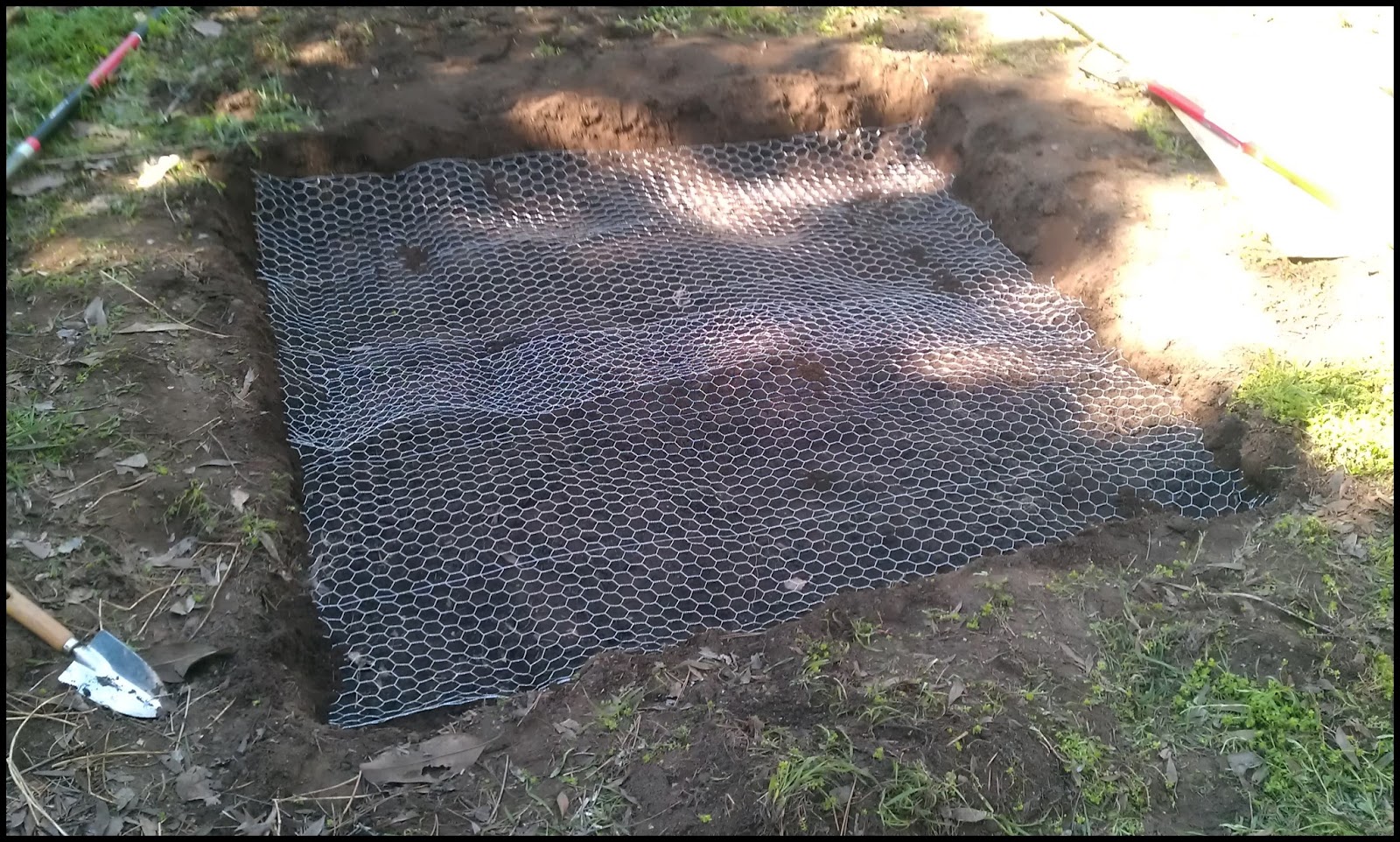
The chicken wire in the 5X5 bed.


Measure and Cut Your Chicken Wire
One of the beds that will not be a raised bed.
The chicken wire I purchased was 3ft wide and 50ft long. I cut two 5ft long pieces. I laid one of these 3ftX5ft pieces in one of the 5ftX5ft holes and then laid the second 3ftX5ft piece next to it. It is okay if they overlap, that is just added protection against the gophers.

I did the same for the second 5ftX5ft bed.

For the 2.5X6ft beds, I cut two 6ft pieces, giving me two 3ftX6ft pieces of chicken wire. I then laid one piece in each hole. It is important that the chicken wire come up the sides of these beds a bit. This will help keep the gophers from entering the bed from the side.

The finished 5X5 bed, without the dirt. :)


Make the Wooden sides of the Raised Bed
I purchased my wood at Home Depot and had them cut it for me. I took four pieces of wood (10inX5ft) and screwed them together (using two screwed for each corner) to create a raised bed.

I repeated the process for the second raised bed.

My new garden. The bed to the right still needs more dirt.
We also cannot dig level beds, but all in all, I think the
gophers will have to be some crafty buggers to get my
veggies!


Fill Your Holes/ Garden Beds with Dirt
This was the fun part, as you really get to see your garden beds come to life - well as much life as there is before you see all the plants emerge!

I am using primarily the dirt from the yard, but I also added a, organic garden dirt and some dirt specifically for raised beds, to help with drainage.

Let me know your thoughts. I plan to post pictures of the garden once it starts growing. Currently the plants are growing in little pots, in an area of the yard that actually gets 6 or more hours of sun. My fingers are crossed that the new beds will get full sun in the summer!

Kitchen Table Redo Tutorial

2
COM

After working my way through a very lengthy, but cathartic, furniture project, I feel compelled to share my process, as well as my successes and failings.

Below is the tutorial I have put together, which details the process I took to complete this project! If you are interested in reading my blog posts while I worked on this project, check out the links at the bottom of the tutorial! :)

Prep Time:   One trip to Home Depot
Work Time:   24 Hours
Total Project Time: 72 hours (includes dry time)

Supplies


Purchase Materials:
  • Zinsser Cover Stain Oil Based Primer - $9
  • Minwax water-based Polycrylic - $18
  • Paint of your choice - $9
  • Two medium grit sanding blocks - $7
  • Three paint brushes - $15
  • Dust/paint fume masks - $3
Total:   $61


Lightly Sand Surface:

I took a medium grit sanding block and very lightly, and I mean very, very lightly, sanded down every inch of the table and chairs you plan to paint. This is done to give the primer something to grip when it is applied.

The table and chairs after the primer step was complete.


Apply Oil Based Primer:

Take a paint brush and paint the primer everywhere on the table and chairs you sanded and plan to paint. I chose to cover the whole table because I felt that my table would not be complete if the underside was not the same color as everything else. BUT, that is just me.

This step is done instead of sanding. If you plan to stain your furniture, do not apply primer. Primer is used when you do not want to sand down the furniture and instead want to paint it fun colors!

I applied two coats to the table and one coat to each of the chairs. I am not sure a second coat is necessary, but I wanted to make sure the paint would stick and other blogs on furniture projects often do two coats. Give the primer 24 hours to fully dry before you begin painting.

TIP: When you paint, always start with the underside of the furniture  In other words, turn the piece of furniture upside down and paint that side first. If you can paint looking down, as opposed to up and at an angle, you are going to save yourself from a ton of neck and back pain.

After the two coats of paint.


Apply Paint of Choice:

Paint one layer over the entire table and chairs and allow it to dry before you begin another coat. I suggest painting at least two coats. I probably should have painted three coats, but because this process took so much longer than I had anticipated I settled for two, and there are a few spots where the paint is thinner and you can see it if the light hits it just right.

I also found it a bit tricky to paint the chair legs and poles on the chair backs. I developed my own method for painting them, which is to paint side to side and not up and down. I am sure there are some professionals who are sighing or yelling at their computer screens at that, but it worked well for me. I actually saw a ton of brush strokes on the poles when I painted them up and down.

To see pictures of what I mean by "side to side" and "up and down" and for some more painting tips Click Here.

A completed chair!


Apply Polycrylic:

Apply a thin, smooth coat of polycrylic. Allow at least two hours to dry between coats. The milky color is normal, it will dry clear.

I put one coat on all the chairs, two coat on the seat of the chair, two coats on the bottom of the table, and four coats on the top of the table. The directions say to apply two coats, but I wanted to be done with it. So far so good.

This was by far the most daunting and difficult part of the project. I did not enjoy working with the Minwax Polycrylic, but it came out looking really nice when it was finished, so it is a toss up.

My biggest issue with the polycrylic is the tendency for it to bubble when you apply it. It is difficult to smooth it out and if you are unable to to, the bubbles show up on the final product.

For some tips for working with Minwax Polycrylic gathered from a variety of sources Click Here.


Allow at Least 24 Hours to Set:

I let it set for 23 hours, despite internet warnings and the directions on the can. Everything seemed fine, until I picked up a glass that had been sitting on the table for a couple hours. It left a milky, raised ring. I was so upset with myself. BUT, after the ring dried, it not only disappeared, it was no longer raised either. You cannot even tell I almost ruined my table.

After re-reading some polycrylic tips, I am guessing I did not let the polycrylic dry fully before applying another coat. I waited 2-3 hours between each coat, but the temperature and room play a huge role in the drying process. Apparently the colder temperature of my garage was a hindrance to the drying process.

Also, FYI if you have animals, there hair is almost certainly going to become a permanent element of your project.

I guess following directions is always a good idea.

The finished table!
Blog Posts Related to This Tutorial:
Kitchen Table Redo: Part One
Kitchen Table Redo: Part Two
Kitchen Table Redo: Part Two and a Half
Kitchen Table Redo: Part Two and Three Quarters - Painting tips
Kitchen Table Redo: Part Three - Tips for working with Minwax Polycrylic
Kitchen Table Redo: Part Three and a Half - FINISHED